Last week, I attended my first military funeral in Israel.
This week, I attended my second.
The first was in Jerusalem, the second in Tel Aviv. The first family was religious, the second was secular.
The first was for a young soldier in his regular, mandatory army service, barely out of school. I know his father.
The second was for a man my age, an officer in the reserves called up for this war, a father of young children. He was a colleague of mine at work.
There is nothing more heartbreaking than hearing a father say Kaddish for his son.
Except hearing a young wife and mother who faces raising her kids without their father.
There is no war without casualties. Still, Israel's wars have a way of cutting down too many of our best and brightest young men.
There will be other opportunities to discuss the management of this campaign, including the errors made by our political and military leaders. There will be plenty of time to assess its outcome and debate its ramifications.
First of all, we must not forget to take the time to mourn.
Friday, August 11, 2006


Tuesday, July 25, 2006
Bunker busting or mosque deconstruction?
Last week, Israel bombed a claimed Hezbullah command bunker in southern Beirut, with dozens of warplanes dropping some 23 ton of explosives on the building. Hezbullah, for its part, said the building was nothing more than a mosque under construction, and not a military target of any sort.
As a civilian and a layman, I have no way of assessing these claims. They may both be true: the mosque construction site may serve as cover for the bunker. Or Hezbullah may be lying. Or Israeli intelligence may have been wrong.
Fortunately, the Middle East is blessed with a plethora of objective journalists to help us sort truth from fiction. (Yes, that was sarcasm.) So I watched eagerly a few days later as a CNN reporter was allowed to visit the site of the attack.
To be fair, he noted that Hezbullah had refused access to journalists for the first day or so after the bombing, so the area seemed to be sensitive. And he couldn't know what may have been removed from the scene before he arrived.
But the pictures he broadcast showed, very clearly, a mosque under construction. Somewhat damaged, but substantially intact. And, he noted, there didn't seem to be much more than a basement underneath it. There was damage to the surrounding buildings, as well. But no bunkers in sight.
Case closed?
Not quite.
I've never seen a building which had been bombarded with 23 tons of explosives, so I can't tell you what it would look like. But I'm pretty sure it wouldn't look like a mosque under construction. Whatever it had looked like the day before.
Going after Hamas terrorists in Gaza, Israel can typically destroy a building with a quarter-ton to one-ton bomb. This attack was supposedly 20-100 times more powerful than that. Granted, a mosque may be larger and stronger than a typical residential building, but remember Israel was aiming to destroy a complex of reinforced bunkers underneath the building. After an assault like that, is it conceivable that the half-built mosque on the site was still recognizable as such?
There are only two possible explanations. Either Israel didn't really drop 23 tons of bombs on the building (Could most of them have missed? Unlikely) - or Hezbullah took the journalists to the wrong site.
Guess which I think is more likely.
Monday, July 24, 2006
You know you haven't been blogging lately when...
...your blog's URL doesn't show up among your browser's auto-completion options!
Really. It's been that long since I've even opened my own homepage.
Meanwhile, a few things have happened:
I'm not going to say much about the war, since there's too much to say and everyone else is saying it. Overall, I think Israel's leaders have been doing a good job so far, with God's help. I didn't vote for Ehud Olmert or Amir Peretz, and I oppose their long-term visions for Israel, but I have to give them credit for the way they've handled the current crisis so far. I only hope and pray they succeed in achieving as many as possible of Israel's strategic objectives with the minimum possible casualties.
The best analyses I've seen of Israel's military and diplomatic strategy have been from Stratfor. The site features free daily podcasts, and you can subscribe to their free commentaries. Their main error has been in underappreciating how reluctant Israel is to launch a major ground invasion of Lebanon, due to our painful experiences in the past.
Military tactics aside, I suspect one of the reasons the IDF has focused on air attacks and minor ground incursions has been to demonstrate to the Israeli public that Hezbullah can't be defeated that way, thus gradually accustoming the public to accept the need for a ground campaign. Also, while going in on the ground may yield the best results, it also carries the greatest risk. Too many casualties and we could turn our current modest success into a perceived defeat, ending worse off than we started.
It's all so complicated, the interplay between the military, diplomatic and domestic fronts. I said I wouldn't say much, so I won't unless people really want to hear it. Enough for now.
Here are some of the topics I have tentatively lined up, time permitting. Let me know what interests you, and I'll bump it forward. (Though the first one will presumably be first, for obvious reasons.)
Or maybe you didn't miss me in the first place, and wish I'd crawl back into my hole. Whatever you say. You're the audience.
Really. It's been that long since I've even opened my own homepage.
Meanwhile, a few things have happened:
- I've actually gotten things done at work.
- Josh in The Styx has returned from a year-long blogging hiatus with a rapid-fire burst of energetic blogging.
- Leiah from Letters from Israel has returned from a nearly two-year hiatus with new letters, and a new blog site.
- At least two more people have discovered who I am. Serves me right for dropping too many hints.
- My learning progressed, then stalled again.
- The baby started talking and walking, and continues to daily amaze her worn-out parents.
- Israel went to war against Lebanon. You may have heard about it.
I'm not going to say much about the war, since there's too much to say and everyone else is saying it. Overall, I think Israel's leaders have been doing a good job so far, with God's help. I didn't vote for Ehud Olmert or Amir Peretz, and I oppose their long-term visions for Israel, but I have to give them credit for the way they've handled the current crisis so far. I only hope and pray they succeed in achieving as many as possible of Israel's strategic objectives with the minimum possible casualties.
The best analyses I've seen of Israel's military and diplomatic strategy have been from Stratfor. The site features free daily podcasts, and you can subscribe to their free commentaries. Their main error has been in underappreciating how reluctant Israel is to launch a major ground invasion of Lebanon, due to our painful experiences in the past.
Military tactics aside, I suspect one of the reasons the IDF has focused on air attacks and minor ground incursions has been to demonstrate to the Israeli public that Hezbullah can't be defeated that way, thus gradually accustoming the public to accept the need for a ground campaign. Also, while going in on the ground may yield the best results, it also carries the greatest risk. Too many casualties and we could turn our current modest success into a perceived defeat, ending worse off than we started.
It's all so complicated, the interplay between the military, diplomatic and domestic fronts. I said I wouldn't say much, so I won't unless people really want to hear it. Enough for now.
Here are some of the topics I have tentatively lined up, time permitting. Let me know what interests you, and I'll bump it forward. (Though the first one will presumably be first, for obvious reasons.)
- Remember Israel's assault last week on a supposed Hezbullah bunker in Beirut? I've got some thoughts about it.
- Was the withdrawal from Lebanon in 2000 a mistake?
- Did you know children's cartoons in Israel employ linguistic advisors? Really!
- Some questions about food and drink in the Talmud
- Simchat Bat - How do/should religious families celebrate the birth of a daughter?
- More about road accident statistics ("A leading cause of death in Israel?")
Or maybe you didn't miss me in the first place, and wish I'd crawl back into my hole. Whatever you say. You're the audience.
Monday, June 12, 2006
Israel and the Palestinians playing the game of Hex
 Has anyone ever played the game of Hex? Quoth Wikipedia (ellipses are mine):
Rules
Players have two colors, say "Red" and "Blue".... They take turns placing a piece of their own color on a hexagon. Red's goal is to form a red path connecting two opposite sides of the parallelogram, and Blue aims to connect the other two sides....
Strategy
The game can never end in a tie, a fact found by Nash: the only way to prevent your opponent from forming a connecting path is to form a path yourself.


I was reminded of Hex when I saw the headline on this report from Ha'aretz and AP:
Olmert: Israel ready to create 'contiguous' Palestinian state
LONDON - Prime Minister Ehud Olmert said Monday that Israel is "prepared to pull out from most" of the West Bank and create a "contiguous" Palestinian state.
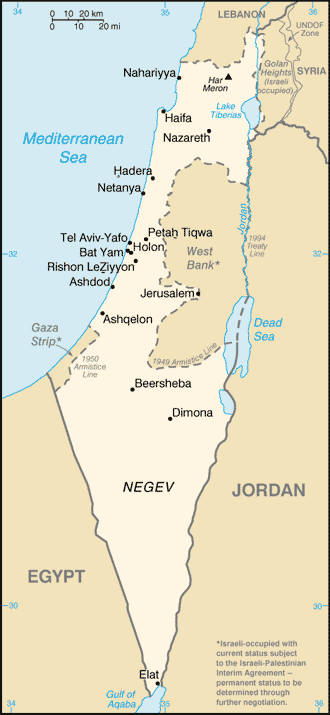 Either Olmert didn't say that, or he doesn't know what he's talking about (or he's being deliberately obfuscatory). As even the New York Times has finally realized (hat tip: Soccer Dad), Gaza and the West Bank are not contiguous. The only way to create a contiguous Palestinian state is by splitting Israel in two, granting the Palestinians a sovereign corridor between the mountains and the sea (as they have consistently demanded).
As in Hex, "the only way to prevent your opponent from forming a connecting path is to form a path yourself." Only one state can be contiguous. All the talk about "two states, living side by side" (Bush) or "a Palestinian state alongside Israel" (the "road map") is meaningless. The choice is between a Palestinian state sandwiching Israel, a Palestinian state bisecting Israel, or a Palestinian state partly encircled by Israel. There is no other way to make a Palestinian state. (Veteran readers know I don't believe there will ever be one, but that's beside the point.)
So what did Olmert mean? The Jerusalem Post has a more extensive quote in its version of the story. It quotes Olmert as saying, "...we will have to move forward... to separate from the Palestinians, pull out from areas of the West Bank to realign Israelis to other parts of Israel to leave a very large contiguous territories for a state to be formed by the Palestinians."
That's different, isn't it? It doesn't specify that the Palestinian state will be contiguous, only that it will comprise "very large contiguous territories." Now, I'm not pleased with that prospect, and furthermore I don't believe that the Palestinians will create a sovereign state no matter how much contiguous territory Israel evacuates. But at least it's geographically possible.
Unfortunately, Olmert wasn't nearly so coherent last month in Washington. He spoke before Congress about "a Palestinian state, side by side in peace and security with Israel." At the White House, he referred to "a contiguous territory that will allow the Palestinians to establish their own Palestinian state alongside the state of Israel." Whether "side by side" or "alongside", it's still physically impossible.
So, which will it be? Will the Palestinian state be contiguous, or will Israel remain in one piece?
I hope our leaders are good at Hex.
(Incidentally, the game of Hex is also an apt analogy for the strategies of Jewish and Arab settlement in the West Bank, as well as land development in the Negev and Galilee. But I don't have time to go into that here.)
Wednesday, June 07, 2006
Cryptic comments
Every blogger no doubt gets the occasional strange comment. But suddenly I've had three in the same week, all sent by anonymous e-mail without any identifying information. All have been a single line of text in poorly-written English, indicating to me that the author(s) is/are not native English speaker(s).
I understand that some may resort to my e-mail form rather than comment directly using Blogger, which requires registration (an anti-spam measure on my part). But please: If you comment on the form, let me know what the heck you're talking about! At least mention which post you're responding to.
Since last Wednesday, I've received the following three e-mails:
The similarities in style and spelling hint to me that these are all from the same reader. I don't really care who it is. I'd just like to know what on earth he/she is referring to.
Any ideas?
I understand that some may resort to my e-mail form rather than comment directly using Blogger, which requires registration (an anti-spam measure on my part). But please: If you comment on the form, let me know what the heck you're talking about! At least mention which post you're responding to.
Since last Wednesday, I've received the following three e-mails:
Best of the text i read about a problem.
We are wellocme to it's configuration.
Wellcome to the real world.
The similarities in style and spelling hint to me that these are all from the same reader. I don't really care who it is. I'd just like to know what on earth he/she is referring to.
Any ideas?
Wednesday, May 31, 2006
The answer is...
Only one taker for the Hebrew calendar quiz?
Well, if you want to work on it yourself don't read past this point. Spoilers follow.
Start with the axioms, as the mathematicians call them. Each month in the Hebrew calendar is either 29 or 30 days long, usually alternating between them, since the lunar month averages about 29.5 days. The first day of each month is Rosh Chodesh, and the 30th day of each 30-day month is also Rosh Chodesh for the following month. So a 29-day month has one day of Rosh Chodesh, while a 30-day month has two.
Consequently, between the end of one Rosh Chodesh and the start of the next, there are always exactly 28 days: days 2 through 29 of each month. That's four whole weeks. As a result, the next Rosh Chodesh always starts on the succeeding day of the week from the end of the previous Rosh Chodesh.
If Rosh Chodesh for month m ends on Tuesday, Rosh Chodesh for month m+1 must start on Wednesday. It may or may not extend to Thursday, depending on the length of month m.
How many days of Rosh Chodesh are there in a year? Twelve months, half of which have 30 days, should yield an average of 18 days of Rosh Chodesh. A couple of days either way don't affect the answer, though, since whether there are 15 days or 21 days, the number is more than two weeks' worth and no more than three weeks.
No matter what day you start, 18 successive days of the week (or 15 or 21) must include at least two Shabbatot, and no more than three. That's the answer to the first question: Either two or three.
The precise answer for a given year will depend primarily on which day Rosh Hashana starts. If it starts on Shabbat, Rosh Chodesh Heshvan starts on Sunday and the remaining days of Rosh Chodesh for the year will include only two Shabbatot (note that Rosh Hashana itself is not generally considered to be Rosh Chodesh, even though it technically is). If R"H starts on Friday, Heshvan will start on Shabbat, and three Shabbatot will fall on Rosh Chodesh that year. And so on.
The bonus question is indeed more difficult, and I'll leave it open for now. Partly to give you something to think about over Shavuot, partly because I haven't worked it out completely myself yet.
Chag Sameach!
Monday, May 29, 2006
Hebrew calendar quiz questions
Without looking at a calendar, how many times a year can Rosh Chodesh fall on Shabbat? Give the minimum and maximum possible in a single Hebrew year (Tishrei through Elul). I'm looking for the reasoning here, not primarily whether or not you have the right answer.
Bonus question: How many times a year is the "Machar Chodesh" haftarah recited?
Sunday, May 14, 2006
Lag Ba'Omer is based on a typo!
Every Israeli schoolchild knows that Lag Ba'Omer celebrates Rabbi Shimon Bar Yochai (Rashbi), the Mishnaic sage who died on that day. The schoolchildren, it turns out, have been misled by an ancient typo.
Reporting in last Friday's Makor Rishon, Hagai Segal describes the research of Rabbi Avraham Kosman of Jerusalem. Having finally gained access to fascimiles of original manuscripts, Rabbi Kosman discovered that the day which was originally described in the writings of the Ari, R' Yitzhak Luria, as "Rashbi's celebration" was transformed via scribal error to "Rashbi's death".
This goes some way towards explaining the odd phenomenon of a Jewish festival celebrating the death of a sage.
Furthermore, he has uncovered evidence that Lag Ba'Omer may have originally been a fast day associated with an aborted attempt to build the third Beit Hamikdash - and that it may have even earlier roots back to King Solomon's day.
The article, available only in Hebrew, is here.
I don't suppose it will have any effect on the volume of smoke released into Israel's atmosphere tomorrow night. Close the windows! Cough, cough
Wednesday, May 10, 2006
The problem of celebrating a national-religious Yom Ha'atzmaut
As a "national-religious" Jew, I celebrate Yom Ha'atzmaut in a twofold manner: As a national holiday of the State of Israel, and as a religious holiday of the Jewish people. Like all Zionist Jews, I celebrate the founding of the state and its accomplishments over the years, while as a religious Jew I also thank God for bestowing on us such a precious gift and for the salvation the Jews have enjoyed through it.
The problem is that the modes of these two celebrations do not always coincide.
As a national holiday, Yom Ha'atzmaut is celebrated with public concerts and fireworks, with music and dance in the evening and barbecues in the afternoon. As a religious holiday, Yom Ha'atzmaut is celebrated with festive prayers, featuring additional psalms and songs of praise to God, and, at most Zionist synagogues, the recitation of Hallel in the morning, and at some in the evening as well.
I've lived in Israel for about ten years, but I have yet to find a pragmatic balance between these modes of celebration, particularly in the evening when the festival begins.
Consider the schedule. The sun sets. The synagogue fills up for the festive Maariv prayer, which lasts about half an hour. As we disperse, crowds are gathering in the city's central park for the main event, with performances and fireworks. But with a religious holiday beginning, I feel the need for a festive family meal. Granted, there is no obligatory religious feast for Yom Ha'atzmaut, but this is how Jews celebrate, with festive meals.
If we go to the public party, what will we eat? We'll crowd in with other families trying to get the attention of an overworked fast food vendor, and end up chowing down on pizza or burgers in the park, while hyperactive kids dash back and forth spraying silly string and shaving cream on each other to the amplified boom of the music from the stage. This is hardly civilized, and is certainly far from traditional Jewish modes of religious celebration.
Alternatively, we can go home first and sit down for a proper holiday meal. (Some even hold what they call a "Yom Ha'atzmaut seder", at which they recount the history of the State of Israel and the miracles with which God has blessed us through it.) But by the time we get home, eat, and go out again, we've missed most of the concerts and most of the fireworks. The kids (at least once they're older) are disappointed, and even the adults feel they've missed the big event, as if by having a family meal we haven't shared in the communal celebration of this national holiday.
With a child in the house, I'm more acutely aware of this dilemma than before, and more eager to find a pragmatic solution for coming years. What do other national-religious families do? What is the "tradition" for celebrating Erev Yom Ha'atzmaut, as both a national and a religious festival?
Help me out, folks. Thanks!
Monday, May 08, 2006
The same blatt gemara?
I just received the following e-mail (with typos corrected):
In the absence of a return address, I'll respond here.
First, kol hakavod on noticing! As far as I can remember, you're the first reader ever to comment on my "What I'm learning" sidebar.
Second: No, I haven't always been learning the same page. If you go back to last June, for example, you'll see I've made some progress since then.
Since July, though, my learning time has been severely curtailed by the demands of a small but frenetic individual, who brings joy to every day of my life.
Furthermore, between my intermittent learning and intermittent blogging, I've forgotten to update the learning sidebar lately. So you'll be pleased to hear that I've actually finally finished Mesechet Megilla (at least at the level of depth on which I was learning it) and held a siyum on it (hadran alach v'hadrach alan!).
I've also started moving on in Berachot, currently holding at Daf 43a. And I've started a new masekhet, Shevuot, in which I've already finished the mishnayot and I'm just starting the gemara (Daf 3a). I'm currently prioritizing Berachot, so I might not make much progress in Shevuot for a while. (For the uninitiated, Shevuot is about oaths, not the festival of Shavuot.)
I'll update the sidebar soon to reflect my progress. Meanwhile, you can click on some old posts to see how stagnant I've been lately!
Finally: Thanks for the kind words. Anonymous blogs deserve anonymous fans.
Am I mistaken, or have you always been learning the same blatt gemara? Anyway, I enjoy your comments.
In the absence of a return address, I'll respond here.
First, kol hakavod on noticing! As far as I can remember, you're the first reader ever to comment on my "What I'm learning" sidebar.
Second: No, I haven't always been learning the same page. If you go back to last June, for example, you'll see I've made some progress since then.
Since July, though, my learning time has been severely curtailed by the demands of a small but frenetic individual, who brings joy to every day of my life.
Furthermore, between my intermittent learning and intermittent blogging, I've forgotten to update the learning sidebar lately. So you'll be pleased to hear that I've actually finally finished Mesechet Megilla (at least at the level of depth on which I was learning it) and held a siyum on it (hadran alach v'hadrach alan!).
I've also started moving on in Berachot, currently holding at Daf 43a. And I've started a new masekhet, Shevuot, in which I've already finished the mishnayot and I'm just starting the gemara (Daf 3a). I'm currently prioritizing Berachot, so I might not make much progress in Shevuot for a while. (For the uninitiated, Shevuot is about oaths, not the festival of Shavuot.)
I'll update the sidebar soon to reflect my progress. Meanwhile, you can click on some old posts to see how stagnant I've been lately!
Finally: Thanks for the kind words. Anonymous blogs deserve anonymous fans.
Subscribe to:
Posts (Atom)