Am Echad has tagged me with the book meme. What could be more appropriate for Jewish bloggers?
(I know, it peaked in mid-August and he tagged me a month ago. So I'm late. Again. So what?)
There's only one problem: How can I name just one? On the assumption that no one reads long blog posts anyway (since they're all busy reading books!), I'll limit myself to the "one book" requested, even though most of the questions have many possible answers. No added commentary, either. If you have questions, just ask!
1. Name one book that changed your life:
Horeb, by Rabbi Samson Raphael Hirsch
2. One book you've read more than once:
The Foundation Trilogy, by Isaac Asimov
3. One book you'd want on a desert island:
SAS Survival Handbook: How to Survive in the Wild, in Any Climate, on Land or at Sea, by John 'Lofty' Wiseman
4. One book that made you laugh:
The Hitchhiker's Guide to the Galaxy, by Douglas Adams
5. One book that made you cry:
Probably Cyrano De Bergerac, by Edmond Rostand. Made me laugh, too.
6. One book you wish you'd written:
The Dawn: Political Teachings of the Book of Esther, by Yoram Hazony.
7. One book you wish had never been written:
The Invention of Ancient Israel, by Keith Whitelam
8. One book you're currently reading:
Education and the State: A Study in Political Economy, by E. G. West
9. One book you've been meaning to read:
Crime and Punishment, by Fyodor Dostoyevsky
Whom to tag? Everyone else has probably already done it. So if you're reading this and you blog, consider this an invitation. A personal, warm and sincere one.
Oh, and gmar hatima tova.
Thursday, September 28, 2006


Wednesday, September 20, 2006
Government by the brambles, for the brambles
Writes Hillel Halkin (hat tip: Am Echad):
Etcetera, etcetera. "For years now"? Try "For thousands of years now". The People of the Book need to open it more often. In particular, Judges 9:7-20, commonly known as the Parable of Yotam (Jotham):
The eternal truth: People with genuine skills, talents, creativity and productive ability generally don't go into politics. They have better things to do with their lives. This leaves the political realm dominated by unclever, self-important, self-serving seekers of power and glory. (Hence the overrepresentation of military careerists in Israeli politics.)
This is the way of the world. In Yotam's terms, most politicians have been, are now, and will be brambles. Fortunately, most of them don't do too much damage beyond scratching your ankles. The good ones even manage to provide a bit of shade. Unfortunately, some of them catch on fire and "devour the cedars of Lebanon". Metaphorically speaking, of course.
Any plan to save Israel which depends on the arrival of a selfless, capable and responsible generation of leaders is not a plan, it's a prayer. The appearance of such a leader is a supernatural event, in the sense that it contravenes the way the world normally works.
That's why we pray for the arrival of Mashiach - because it's not possible to plan it and we can't realistically expect it.
Until then, we'll have to manage with the leaders we have to choose from in the real world. However brambly they may be. (Though I agree that our current crop is even more brambly than usual.)
For years now, fewer talented young Israelis have been going into both politics and military life as the attraction and glamour have declined along with the ideal of public service in general.
The Israeli political system has been increasingly dominated by self-serving careerists. A new, up-and-coming generation of capable future leaders with a true sense of national responsibility is hard to discern.
Etcetera, etcetera. "For years now"? Try "For thousands of years now". The People of the Book need to open it more often. In particular, Judges 9:7-20, commonly known as the Parable of Yotam (Jotham):
The trees went forth on a time to anoint a king over them; and they said unto the olive-tree: Reign thou over us. But the olive-tree said unto them: Should I leave my fatness, seeing that by me they honour God and man, and go to hold sway over the trees?
And the trees said to the fig-tree: Come thou, and reign over us. But the fig-tree said unto them: Should I leave my sweetness, and my good fruitage, and go to hold sway over the trees?
And the trees said unto the vine: Come thou, and reign over us. And the vine said unto them: Should I leave my wine, which cheereth God and man, and go to hold sway over the trees?
Then said all the trees unto the bramble: Come thou, and reign over us. And the bramble said unto the trees: If in truth ye anoint me king over you, then come and take refuge in my shadow; and if not, let fire come out of the bramble, and devour the cedars of Lebanon.
The eternal truth: People with genuine skills, talents, creativity and productive ability generally don't go into politics. They have better things to do with their lives. This leaves the political realm dominated by unclever, self-important, self-serving seekers of power and glory. (Hence the overrepresentation of military careerists in Israeli politics.)
This is the way of the world. In Yotam's terms, most politicians have been, are now, and will be brambles. Fortunately, most of them don't do too much damage beyond scratching your ankles. The good ones even manage to provide a bit of shade. Unfortunately, some of them catch on fire and "devour the cedars of Lebanon". Metaphorically speaking, of course.
Any plan to save Israel which depends on the arrival of a selfless, capable and responsible generation of leaders is not a plan, it's a prayer. The appearance of such a leader is a supernatural event, in the sense that it contravenes the way the world normally works.
That's why we pray for the arrival of Mashiach - because it's not possible to plan it and we can't realistically expect it.
Until then, we'll have to manage with the leaders we have to choose from in the real world. However brambly they may be. (Though I agree that our current crop is even more brambly than usual.)
Heads up - new cheesemaking comment
A thoughtful new comment has appeared to my two-year-old post on making cheese from non-kosher animals.
Sunday, August 27, 2006
Time to Boogie?
Anyone touting former Chief of Staff Moshe "Boogie" Yaalon as Israel's Next Great Hope should pay close attention to this story from the Washington Post.
It was a fateful day. The entire Hamas leadership, according to Israeli intelligence, had gathered in a single home in Gaza:
There's more. It's a fascinating article. But the inescapable conclusion, if the report is accurate, is that Yaalon consistently favored the enemy's civilians over our own, however critical the terrorist being targeted.
He may have opposed disengagement (at least behind closed doors), but that doesn't make him a hawk. And neither does it qualify him to join the ranks of Israel's leadership.
It was a fateful day. The entire Hamas leadership, according to Israeli intelligence, had gathered in a single home in Gaza:
The air force chief was on the line, assessing the likely impact of the bomb. He said there was a problem.
A half-ton bomb wouldn't finish the job, the air force chief said. A one-ton bomb would blow out the neighboring apartment building, which was filled with dozens of families.
Immediately, Dichter and Yaalon began to argue. Dichter favored the heavy bomb; Yaalon wanted to abort the operation. They both had worked for decades in counter-terrorism, had served in the same secret commando unit and had, as Dichter put it, "traveled together without passports deep into Arab lands."
But they had emerged with different conclusions. For Dichter, "the barrel of terrorism has a bottom." If you captured or killed enough terrorists, Dichter believed, the problem would be solved. "They deserved a bomb that would send the dream team to hell," Dichter said. "I said, 'If we miss this opportunity, more Israelis will die.' "
Yaalon disagreed: "We won't get to the bottom of the barrel by killing terrorists. We'll get there through education. Dichter thinks we'll kill, kill, kill, kill, kill. That's it -- we've won. I don't accept that."
While Yaalon said the army had to consider the support of the Israeli public -- unlikely to favor civilian deaths -- and international legitimacy, Dichter said that from an operational point of view, a one-ton bomb made sense. "There is no fair fight against terrorists," Dichter said. "Never has been. Never will be."
The debate lasted for hours, observers said, and grew louder and larger. The prime minister's adviser, Gallant, sided with Dichter. The defense minister, Mofaz, sided with Yaalon. Dichter recalled: "If you didn't have a strong heart, you'd have a heart attack."
"How can we look in the eyes of our pilots if they kill innocent people?" Yaalon argued.
"And if the terrorists walk out alive, and tomorrow another bus explodes, how do we explain it to our people?" Dichter said.
....
Only once, Yaalon said, did he knowingly authorize a hit that would also kill a noncombatant, the wife of Salah Shehada. Shehada helped found Hamas's military wing, which had asserted responsibility for killing 16 soldiers and 220 Israeli civilians. In 2002, the air force dropped a one-ton bomb on his home. The blast also destroyed a neighboring house, which Yaalon said he had thought was empty. Fifteen civilians were killed, including nine children. It felt, Yaalon said, "like something heavy fell on my head."
When Yaalon makes this kind of decision, he said, it must pass "the mirror test": At the end of the day, will he be able to look at himself in the mirror?
There's more. It's a fascinating article. But the inescapable conclusion, if the report is accurate, is that Yaalon consistently favored the enemy's civilians over our own, however critical the terrorist being targeted.
He may have opposed disengagement (at least behind closed doors), but that doesn't make him a hawk. And neither does it qualify him to join the ranks of Israel's leadership.
Tuesday, August 15, 2006
Israelis are furiously debating...

...exactly which of the country's political and military leaders must resign or be dismissed.
In the government: Just Olmert? Olmert and Peretz? Olmert, Peretz and Livni? What about Hirschson and Bar-On?
In the IDF: Halutz? Kaplinsky? Adam? Hirsch?
How low should we go?
I have yet to meet an Israeli who believes we won this war. I have yet to find anyone who thinks this government should stay in office any longer than is necessary to replace it. It's not about left or right. This was a war of national consensus, and it has left us with a new national consensus: They must go.
We just have to work out exactly who, and how to get rid of them.
Then we have to figure out who should take their places.
And we have to do it fast, since in the wake of our glorious victory Syria, Iran and the Palestinians are already issuing new threats against us.
There's no time to lose.
Friday, August 11, 2006
Time to mourn
Last week, I attended my first military funeral in Israel.
This week, I attended my second.
The first was in Jerusalem, the second in Tel Aviv. The first family was religious, the second was secular.
The first was for a young soldier in his regular, mandatory army service, barely out of school. I know his father.
The second was for a man my age, an officer in the reserves called up for this war, a father of young children. He was a colleague of mine at work.
There is nothing more heartbreaking than hearing a father say Kaddish for his son.
Except hearing a young wife and mother who faces raising her kids without their father.
There is no war without casualties. Still, Israel's wars have a way of cutting down too many of our best and brightest young men.
There will be other opportunities to discuss the management of this campaign, including the errors made by our political and military leaders. There will be plenty of time to assess its outcome and debate its ramifications.
First of all, we must not forget to take the time to mourn.
This week, I attended my second.
The first was in Jerusalem, the second in Tel Aviv. The first family was religious, the second was secular.
The first was for a young soldier in his regular, mandatory army service, barely out of school. I know his father.
The second was for a man my age, an officer in the reserves called up for this war, a father of young children. He was a colleague of mine at work.
There is nothing more heartbreaking than hearing a father say Kaddish for his son.
Except hearing a young wife and mother who faces raising her kids without their father.
There is no war without casualties. Still, Israel's wars have a way of cutting down too many of our best and brightest young men.
There will be other opportunities to discuss the management of this campaign, including the errors made by our political and military leaders. There will be plenty of time to assess its outcome and debate its ramifications.
First of all, we must not forget to take the time to mourn.
Tuesday, July 25, 2006
Bunker busting or mosque deconstruction?
Last week, Israel bombed a claimed Hezbullah command bunker in southern Beirut, with dozens of warplanes dropping some 23 ton of explosives on the building. Hezbullah, for its part, said the building was nothing more than a mosque under construction, and not a military target of any sort.
As a civilian and a layman, I have no way of assessing these claims. They may both be true: the mosque construction site may serve as cover for the bunker. Or Hezbullah may be lying. Or Israeli intelligence may have been wrong.
Fortunately, the Middle East is blessed with a plethora of objective journalists to help us sort truth from fiction. (Yes, that was sarcasm.) So I watched eagerly a few days later as a CNN reporter was allowed to visit the site of the attack.
To be fair, he noted that Hezbullah had refused access to journalists for the first day or so after the bombing, so the area seemed to be sensitive. And he couldn't know what may have been removed from the scene before he arrived.
But the pictures he broadcast showed, very clearly, a mosque under construction. Somewhat damaged, but substantially intact. And, he noted, there didn't seem to be much more than a basement underneath it. There was damage to the surrounding buildings, as well. But no bunkers in sight.
Case closed?
Not quite.
I've never seen a building which had been bombarded with 23 tons of explosives, so I can't tell you what it would look like. But I'm pretty sure it wouldn't look like a mosque under construction. Whatever it had looked like the day before.
Going after Hamas terrorists in Gaza, Israel can typically destroy a building with a quarter-ton to one-ton bomb. This attack was supposedly 20-100 times more powerful than that. Granted, a mosque may be larger and stronger than a typical residential building, but remember Israel was aiming to destroy a complex of reinforced bunkers underneath the building. After an assault like that, is it conceivable that the half-built mosque on the site was still recognizable as such?
There are only two possible explanations. Either Israel didn't really drop 23 tons of bombs on the building (Could most of them have missed? Unlikely) - or Hezbullah took the journalists to the wrong site.
Guess which I think is more likely.
As a civilian and a layman, I have no way of assessing these claims. They may both be true: the mosque construction site may serve as cover for the bunker. Or Hezbullah may be lying. Or Israeli intelligence may have been wrong.
Fortunately, the Middle East is blessed with a plethora of objective journalists to help us sort truth from fiction. (Yes, that was sarcasm.) So I watched eagerly a few days later as a CNN reporter was allowed to visit the site of the attack.
To be fair, he noted that Hezbullah had refused access to journalists for the first day or so after the bombing, so the area seemed to be sensitive. And he couldn't know what may have been removed from the scene before he arrived.
But the pictures he broadcast showed, very clearly, a mosque under construction. Somewhat damaged, but substantially intact. And, he noted, there didn't seem to be much more than a basement underneath it. There was damage to the surrounding buildings, as well. But no bunkers in sight.
Case closed?
Not quite.
I've never seen a building which had been bombarded with 23 tons of explosives, so I can't tell you what it would look like. But I'm pretty sure it wouldn't look like a mosque under construction. Whatever it had looked like the day before.
Going after Hamas terrorists in Gaza, Israel can typically destroy a building with a quarter-ton to one-ton bomb. This attack was supposedly 20-100 times more powerful than that. Granted, a mosque may be larger and stronger than a typical residential building, but remember Israel was aiming to destroy a complex of reinforced bunkers underneath the building. After an assault like that, is it conceivable that the half-built mosque on the site was still recognizable as such?
There are only two possible explanations. Either Israel didn't really drop 23 tons of bombs on the building (Could most of them have missed? Unlikely) - or Hezbullah took the journalists to the wrong site.
Guess which I think is more likely.
Monday, July 24, 2006
You know you haven't been blogging lately when...
...your blog's URL doesn't show up among your browser's auto-completion options!
Really. It's been that long since I've even opened my own homepage.
Meanwhile, a few things have happened:
I'm not going to say much about the war, since there's too much to say and everyone else is saying it. Overall, I think Israel's leaders have been doing a good job so far, with God's help. I didn't vote for Ehud Olmert or Amir Peretz, and I oppose their long-term visions for Israel, but I have to give them credit for the way they've handled the current crisis so far. I only hope and pray they succeed in achieving as many as possible of Israel's strategic objectives with the minimum possible casualties.
The best analyses I've seen of Israel's military and diplomatic strategy have been from Stratfor. The site features free daily podcasts, and you can subscribe to their free commentaries. Their main error has been in underappreciating how reluctant Israel is to launch a major ground invasion of Lebanon, due to our painful experiences in the past.
Military tactics aside, I suspect one of the reasons the IDF has focused on air attacks and minor ground incursions has been to demonstrate to the Israeli public that Hezbullah can't be defeated that way, thus gradually accustoming the public to accept the need for a ground campaign. Also, while going in on the ground may yield the best results, it also carries the greatest risk. Too many casualties and we could turn our current modest success into a perceived defeat, ending worse off than we started.
It's all so complicated, the interplay between the military, diplomatic and domestic fronts. I said I wouldn't say much, so I won't unless people really want to hear it. Enough for now.
Here are some of the topics I have tentatively lined up, time permitting. Let me know what interests you, and I'll bump it forward. (Though the first one will presumably be first, for obvious reasons.)
Or maybe you didn't miss me in the first place, and wish I'd crawl back into my hole. Whatever you say. You're the audience.
Really. It's been that long since I've even opened my own homepage.
Meanwhile, a few things have happened:
- I've actually gotten things done at work.
- Josh in The Styx has returned from a year-long blogging hiatus with a rapid-fire burst of energetic blogging.
- Leiah from Letters from Israel has returned from a nearly two-year hiatus with new letters, and a new blog site.
- At least two more people have discovered who I am. Serves me right for dropping too many hints.
- My learning progressed, then stalled again.
- The baby started talking and walking, and continues to daily amaze her worn-out parents.
- Israel went to war against Lebanon. You may have heard about it.
I'm not going to say much about the war, since there's too much to say and everyone else is saying it. Overall, I think Israel's leaders have been doing a good job so far, with God's help. I didn't vote for Ehud Olmert or Amir Peretz, and I oppose their long-term visions for Israel, but I have to give them credit for the way they've handled the current crisis so far. I only hope and pray they succeed in achieving as many as possible of Israel's strategic objectives with the minimum possible casualties.
The best analyses I've seen of Israel's military and diplomatic strategy have been from Stratfor. The site features free daily podcasts, and you can subscribe to their free commentaries. Their main error has been in underappreciating how reluctant Israel is to launch a major ground invasion of Lebanon, due to our painful experiences in the past.
Military tactics aside, I suspect one of the reasons the IDF has focused on air attacks and minor ground incursions has been to demonstrate to the Israeli public that Hezbullah can't be defeated that way, thus gradually accustoming the public to accept the need for a ground campaign. Also, while going in on the ground may yield the best results, it also carries the greatest risk. Too many casualties and we could turn our current modest success into a perceived defeat, ending worse off than we started.
It's all so complicated, the interplay between the military, diplomatic and domestic fronts. I said I wouldn't say much, so I won't unless people really want to hear it. Enough for now.
Here are some of the topics I have tentatively lined up, time permitting. Let me know what interests you, and I'll bump it forward. (Though the first one will presumably be first, for obvious reasons.)
- Remember Israel's assault last week on a supposed Hezbullah bunker in Beirut? I've got some thoughts about it.
- Was the withdrawal from Lebanon in 2000 a mistake?
- Did you know children's cartoons in Israel employ linguistic advisors? Really!
- Some questions about food and drink in the Talmud
- Simchat Bat - How do/should religious families celebrate the birth of a daughter?
- More about road accident statistics ("A leading cause of death in Israel?")
Or maybe you didn't miss me in the first place, and wish I'd crawl back into my hole. Whatever you say. You're the audience.
Monday, June 12, 2006
Israel and the Palestinians playing the game of Hex
 Has anyone ever played the game of Hex? Quoth Wikipedia (ellipses are mine):
Rules
Players have two colors, say "Red" and "Blue".... They take turns placing a piece of their own color on a hexagon. Red's goal is to form a red path connecting two opposite sides of the parallelogram, and Blue aims to connect the other two sides....
Strategy
The game can never end in a tie, a fact found by Nash: the only way to prevent your opponent from forming a connecting path is to form a path yourself.


I was reminded of Hex when I saw the headline on this report from Ha'aretz and AP:
Olmert: Israel ready to create 'contiguous' Palestinian state
LONDON - Prime Minister Ehud Olmert said Monday that Israel is "prepared to pull out from most" of the West Bank and create a "contiguous" Palestinian state.
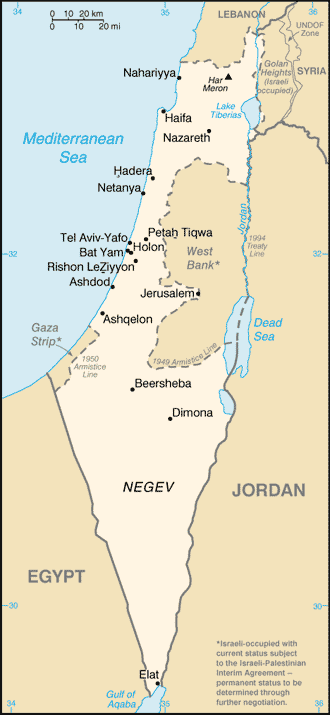 Either Olmert didn't say that, or he doesn't know what he's talking about (or he's being deliberately obfuscatory). As even the New York Times has finally realized (hat tip: Soccer Dad), Gaza and the West Bank are not contiguous. The only way to create a contiguous Palestinian state is by splitting Israel in two, granting the Palestinians a sovereign corridor between the mountains and the sea (as they have consistently demanded).
As in Hex, "the only way to prevent your opponent from forming a connecting path is to form a path yourself." Only one state can be contiguous. All the talk about "two states, living side by side" (Bush) or "a Palestinian state alongside Israel" (the "road map") is meaningless. The choice is between a Palestinian state sandwiching Israel, a Palestinian state bisecting Israel, or a Palestinian state partly encircled by Israel. There is no other way to make a Palestinian state. (Veteran readers know I don't believe there will ever be one, but that's beside the point.)
So what did Olmert mean? The Jerusalem Post has a more extensive quote in its version of the story. It quotes Olmert as saying, "...we will have to move forward... to separate from the Palestinians, pull out from areas of the West Bank to realign Israelis to other parts of Israel to leave a very large contiguous territories for a state to be formed by the Palestinians."
That's different, isn't it? It doesn't specify that the Palestinian state will be contiguous, only that it will comprise "very large contiguous territories." Now, I'm not pleased with that prospect, and furthermore I don't believe that the Palestinians will create a sovereign state no matter how much contiguous territory Israel evacuates. But at least it's geographically possible.
Unfortunately, Olmert wasn't nearly so coherent last month in Washington. He spoke before Congress about "a Palestinian state, side by side in peace and security with Israel." At the White House, he referred to "a contiguous territory that will allow the Palestinians to establish their own Palestinian state alongside the state of Israel." Whether "side by side" or "alongside", it's still physically impossible.
So, which will it be? Will the Palestinian state be contiguous, or will Israel remain in one piece?
I hope our leaders are good at Hex.
(Incidentally, the game of Hex is also an apt analogy for the strategies of Jewish and Arab settlement in the West Bank, as well as land development in the Negev and Galilee. But I don't have time to go into that here.)
Wednesday, June 07, 2006
Cryptic comments
Every blogger no doubt gets the occasional strange comment. But suddenly I've had three in the same week, all sent by anonymous e-mail without any identifying information. All have been a single line of text in poorly-written English, indicating to me that the author(s) is/are not native English speaker(s).
I understand that some may resort to my e-mail form rather than comment directly using Blogger, which requires registration (an anti-spam measure on my part). But please: If you comment on the form, let me know what the heck you're talking about! At least mention which post you're responding to.
Since last Wednesday, I've received the following three e-mails:
The similarities in style and spelling hint to me that these are all from the same reader. I don't really care who it is. I'd just like to know what on earth he/she is referring to.
Any ideas?
I understand that some may resort to my e-mail form rather than comment directly using Blogger, which requires registration (an anti-spam measure on my part). But please: If you comment on the form, let me know what the heck you're talking about! At least mention which post you're responding to.
Since last Wednesday, I've received the following three e-mails:
Best of the text i read about a problem.
We are wellocme to it's configuration.
Wellcome to the real world.
The similarities in style and spelling hint to me that these are all from the same reader. I don't really care who it is. I'd just like to know what on earth he/she is referring to.
Any ideas?
Subscribe to:
Posts (Atom)