Monday, November 07, 2011

Roadkill myths IV: End-of-2010 update

Six years ago, back in 2005, I wrote a series of essays on road safety statistics in Israel. With six more years of data available, and the subject resurfacing lately in the Israeli media, it's time for an update.

To get the most out of this post, please read (or reread) at least the first two of my original essays. I'll be here when you get back.

Ready?

With data now available through 2010, what has changed?

As in my previous essays, we need to look at several types of statistics: 1) the total annual number of fatalities, 2) the fatality rate per capita, 3) the fatality rate per kilometer driven, and 4) Israel's international ranking in fatalities per capita and 5) per kilometer driven.

If you had asked me then what I expected the data to look like in six years, I would have anticipated a continuation of the established trends: steady, gradual improvements in the fatality rates, with occasional setbacks along the way. The trend in total fatalities is harder to predict, as it depends on the interaction between the falling per-kilometer rate and the rising total distance driven. Given the tailing off of the post-Soviet immigration, I might have anticipated a modest fall in total fatalities, but now I'm second-guessing my former self.

So what actually happened?


1) Total annual fatalities

Based on the data through 2004, I wrote: "Annual fatalities have been stuck at 450-550 for over fifteen years now." Already, we see a significant change (click image to enlarge):

In 2005, the annual fatality total fell below 450 for the first time since 1991. But that's not all. In 2007, it fell below 400 - all the way to 382 - for the first time since 1985, 22 years earlier. Then, incredibly, in 2009 it plummeted to 314, the lowest level since 1963!

Unfortunately, in 2010 the number bounced back up to 352, and it looks likely to exceed that in 2011. This is an example of what statisticians call regression toward the mean. When a statistic trends in a particular direction, sometimes it will overshoot its long-term trend and sometimes it will undershoot it. While it may appear to have gotten much better and much worse, in fact it mainly reflects random variance around its trend line. (Even while total fatalities remained largely stable between 1987 and 2004, the total changed by as much as 17.5% a year in either direction.)

Overall, between 2004 and 2010, the total number of annual Israeli road fatalities fell by an average of 5.0%/year, for a total of 27%. That's significant.


2) Fatality rate per capita

In 2005, I noted that fatalities per capita had showed a gradual improvement since 1980. The 2004 figure was 7.0 per 100,000 population, falling at an average 1.6%/year over the preceding five years. It would have been reasonable to expect that trend to continue.

But the decline not only continued, it accelerated:


Over six years, the fatality rate per capita improved by 34%, falling an average 6.7% per year. That's over four times the decline rate of the previous five years.

In 2010, it fell as low as 4.7 per 100,000 (having regressed from 2009's record low of 4.2). As the graph makes clear, values in this range are entirely unprecedented in Israel.


3) Fatality rate per distance driven

In 2004, fatalities per distance driven were at 12 per billion vehicle-km and falling at 2%/year. As with the other figures, this too showed a dramatic improvement through 2010:


Or, to zoom in on the last 20 years:


In six short years, fatalities per kilometer fell by a whopping 42% to just 7 per billion vehicle-km, an average decline of 8.5% a year. (The record low in 2009 was 6.4.)

So if anyone tells you that road safety in Israel is again getting worse, now you know the facts. The recent deterioriation is a short-term statistical fluctuation greatly overwhelmed by dramatic long-term improvements.

I'll save the international comparisons for a followup post. Brace yourself for more good news.

Wednesday, August 24, 2011

No, God was not punishing Obama

Emerging from hibernation to address an issue of vital national importance...


Within minutes of the exceptional east coast earthquake, the net was buzzing with claims that it was God's way of punishing Obama for some disfavored policy or other. Most of these were probably in jest, but not all of them, it would seem.


We heard the same nonsense about Katrina. All the rebuttals apply, but more so. The idea doesn't make sense if you think about it for longer than it takes to send a tweet. It amounts to "Big earthquake near Washington - what more proof do you need?"


So for these misguided souls and others who may be misguided by them, I give you...


Why the earthquake was not a divine punishment of Obama:


If God wanted to punish Obama, why did the earthquake hit Washington (well, about 80 miles south of Washington) just when he was in Martha's Vineyard? Did He forget to check the president's official schedule? Or maybe God's aim is way off?


If God wanted to punish Obama, why did the earthquake hit when he was on vacation? Was he being punished for playing golf? Why didn't it hit while he was delivering a policy address, or at least busy at work in the Oval Office?


If God wanted to punish Obama, why did the earthquake cause so little damage and so few injuries? Was this some kind of warning shot? Does God even do shots across the bow? Some punishment, huh?


And then of course there's the whole ambiguity thing. Exactly what policy is God supposed to be punishing? His stance on Israel? Abortion? Gay marriage? Corporate taxes? The debt ceiling deal? What would motivate God to mete out a vague, unspecified "punishment" which didn't even hit the president, or virtually anyone else? For that matter, how do we even know this punishment was aimed at Obama, as opposed to Congress, the Supreme Court, the D.C. city council, or even Fred from Alexandria on line 1?


At this point, sensible people realize they've drawn an unsupported conclusion and admit their error. Others, though, will try to engage in sophistry to explain why in fact it does make sense to interpret this as a form of divine retribution against the president. The quake could actually be felt on Martha's Vineyard, they'll say. Washington clearly symbolized the president. And Washington was hit hard, even if not directly. What else could a historically-strong earthquake represent but divine displeasure? etc., etc.


But press them on how they can know their interpretation to be correct when none of the details are quite right, and they may explain that it's close enough - we can't expect to understand precisely how God works in this world.


Exactly. We don't understand how God works in this world. So stop claiming that you do. Especially when it doesn't make sense!

Sunday, November 22, 2009

How to disperse haredi demonstrations against Shabbos violations

A simple nonviolent technique: The police need to set up an electric eye which triggers halogen floodlights. No honest haredi can cross that beam on Shabbos!

Sunday, March 01, 2009

The anti-Reagan feeds the beast

In the Reagan years, some conservative wonks supported tax cuts not because they really believed in their stimulative effects, but because they wanted to "starve the beast" - that is, government. (See this typically biased Wikipedia citation for references.)

Government had grown too large and intrusive, and it was politically impossible to cut government programs. But tax cuts, and the ensuing revenue reductions, would force spending cuts by starving government of the revenues it needed to keep growing. With tax increases no less politically hazardous then spending cuts, growing deficits would eventually make it possible, if not necessary, to cut back the state. Tax cuts today would give rise to spending cuts tomorrow. (Or so they thought; reality was a bit different.)

I mention this because President Obama seems to have adopted the reverse theory.

He wants to "feed the beast" today, introducing an unprecedented parade of new government programs under the rubric of economic stimulus. But he knows he doesn't have the political support to pay for them with new taxes, and even if he did they couldn't be imposed during a looming recession. But over time, as the new programs develop entrenched constituencies and become politically impossible to cut, the enormous and growing deficits will create irresistible pressure to increase taxes to cover the gap. Spending on new programs today will give rise to new taxes tomorrow.

Or so he thinks. Reality has plenty of time for the final word.

Monday, February 16, 2009

Haveil Havalim #20X

It's been a long time since I've appeared in Haveil Havalim, the Jewish/Israel blog carnival. This week it's at Here in HP, by Leora. I've been away so long I haven't the faintest idea who or what that is, but well done Leora!

Thursday, February 05, 2009

The real reasons Israel can't play the violin

"Doctor, when my arm heals will I be able to play the violin?"
"Sure - I don't see why not."
"Great! I could never play it before!"
-- A bad joke with an important point.

Israel is afflicted with diplomatic "doctors" like the one in that joke. They identify one reason why Israel has not achieved peace - sometimes a true and important reason - and then jump to the groundless conclusion that solving that issue will therefore bring peace. But like the patient who won't be able to play the violin even after his arm heals, Israel will not have peace even after the alleged cure, because the state of war is due to fundamental conditions it fails to address. If you never learn to play the violin, it doesn't matter how healthy your arm is.

So we read, time and again, self-proclaimed analysts explaining that "the settlements make a peace deal impossible." That may be true, I admit. But it does not imply that removing them would make a deal possible. Just as evacuating Gaza (or Lebanon) did not bring peace any closer there. The state of war was not a result of Israel's presence in Gaza, but if anything a cause of it. Eliminating the effect cannot remove the cause.

"Israel will not have peace without dividing Jerusalem." Again, that may be. But neither will we have peace if we do divide Jerusalem, God forbid.

"There is no military solution to the Arab-Israeli conflict." Perhaps. But that doesn't mean there is a potential diplomatic solution.

"Syria won't agree to peace without the entire Golan." Probably not. But all indications are that even forfeiting the entire Golan would not bring peace with Syria.

"The Palestinians can't strike a deal as long as they're divided between Fatah and Hamas, West Bank and Gaza." True again. But there's no evidence that they could strike a deal were they undivided either.

The worst culprits tend to be those Western liberal academics who tell us that "the terms of a final-status peace agreement are known; what's missing is the political will on both sides to implement it." As if there's a well-defined set of legalistic, logistical and structural arrangements which could yield peace were they only implemented.

If both sides were comprised of Western liberal academics, that may be the case. But we're not, on either side. Israelis and Arabs have fundamental differences in our attitudes to this land and our rights to it. That's what the so-called experts dismiss as "political will." But all the tunnels, bridges and international forces in the world can't bridge those gaps in attitudes and goals. Peace is not being blocked by the lack of logistics, but by essential and apparently unbridgeable differences of outlook.

Ultimately, Israel will not have peace until its Arab neighbors come to accept that we have the right to sovereignty here as a Jewish state - or at least that we're not going anywhere in the foreseeable future, and so they have more important things to do than continue fighting us in vain. Without one of those changes in Arab mindset, all the arm-healing in the world won't teach them to play the violin. None of the other alleged obstacles to peace is relevant so long as the core grievance remains.

Wednesday, January 28, 2009

Who should I vote for, 2009 version

In March 2006, last time national elections came around, I discussed how I perceived the choice of parties and which one I decided to vote for. Time has come for another round of Wheel of Proportion(al representation).

Rereading the old post, it's interesting how much has changed, and how much has stayed the same. On the one hand, the constellation of major parties likely to enter the Knesset has remained the same, except for the fissioning of the NRP/National Union. On the other hand, most of them have replaced their leaders.

The biggest changes, though, have been in the geopolitical situation. Oddly, these changes are only somewhat reflected in the political campaigns; many of the parties seem to think they can keep hitting their old themes and slogans without reacting to the changes around them.

In 2006, remember, Olmert's Kadima ran on a promise of further unilateral territorial concessions, including substantial withdrawals from Jewish settlements in Judea and Samaria. This time around, after Hizbullah's success in Lebanon and the Hamas occupation of Gaza, no one's talking about that. We've given our enemies enough rocket launching areas, thank you very much.

But rather than reach the obvious conclusion that there is no diplomatic solution to the Israel-Palestinian conflict, Olmert and Livni have been busy negotiating with Abbas under the Annapolis process. Even in the unlikely case we could reach a deal with Abbas, what good will it do as long as Hamas controls Gaza and the Palestinian parliament? On that, Livni is mum.

Labor continues to talk about war and peace as if nothing of interest has changed. It's also shamelessly exploiting the Gaza campaign to score political points. What, are they trying to confirm the cynics who claim Barak went to war because of the elections? Heck, I'm not sure I'd put it past him myself.

Considering the choices of right-wing parties I briefly flirted with Lieberman and Yisrael Beiteinu. But seeing his campaign, which is solely based on fanning the flames of hatred towards Israel's Arab citizens, he holds no appeal to me whatsoever. I have no illusions about the challenges Israel faces from its Arab population, but we gain nothing by deliberately demonizing them. Disgusting.

Shas is striking a hawkish note, attacking Livni for refusing to rule out negotiating over Jerusalem. Okay, but everything short of that is okay with them? I expect so.

Which narrows me down to the usual suspects: Likud, NRP (now "the Jewish Home"), and the National Union. (By coincidence, I know at least one of the candidates in a realistic slot in each of the three parties.)

From the Likud this time around I hear a substantial - and refreshing - change of tone. No more talk about working for a negotiated settlement or expectations of peace. Netanyahu is talking soberly about the challenges we face and the hard choices to be made. No more "I'll bring you peace with security, or security with peace." Netanyahu has put forward a plan for "economic peace", suggesting that in the absence of real prospects for a diplomatic agreement we work on agreed steps to help the Palestinian economy. Frankly, I think that's a crock, but it's a potential way to maintain a diplomatic track which doesn't entail unrealistic expectations or unacceptable demands. In other words, it may be a way to buy time while filling the diplomatic void with something concrete.

I'm less sanguine about his economic program. It's nice to hear him talk about tax cuts - no one else is - but it's plain that his promise of a 20% cut over four years is unrealistic, especially with global economic crisis. Why set himself up for failure, when he could set a more modest but achievable goal?

Do I trust Bibi? Do I look forward to his leadership? Not particularly. But I'm still in general agreement with his positions, more so than any of his rivals. And Likud has plenty of good candidates who are reliable security hawks, including representatives of Feiglin's Jewish Leadership faction. Likud may actually elect more religious Knesset members this time around than either of the religious-Zionist parties.

Then there's the NRP. My natural political home, one would think. Yet, when you get past the flags and knitted kipot, what exactly do they stand for? What is their record of legislative effectiveness? Why do they think it makes sense to populate most of their list with novice politicians? They're opposed to territorial withdrawals, but stayed in the Sharon government until the last moment. Their economic platform seems to confuse Judaism with socialism. Their educational program is generally based on increased budgets for religious schools, but does anyone think the real problems with the religious schools are financial? I love Uri Orbach, and I respect the records of the rest of the list, but what do they plan to accomplish in the Knesset? Wrest the rabbinate from Shas? Unlikely.

And the National Union. Again, I admire Ketzeleh, but what legislative experience does he have? I also have a serious problem with the partnership with the neo-Kahanist crowd, and in general with the factions which have started to turn against the legitimacy of the state. And there's virtually no chance of them joining a coalition - in the current diplomatic climate, no government will openly agree to funding the settlements. So a vote for them might only help drive Bibi into a unity coalition; he'd rather prop up Labor against Kadima than be seen as caving in to the demands of radicals. Finally, I'm still disappointed with Uri Ariel for splitting the religious-Zionist camp - though I'm aware it might also salvage thousands of votes which would otherwise be wasted on fringe right-wing parties.

All that said, I have to decide how strongly I want Netanyahu to lead the next government. The stronger the Likud, the more likely he is to get the nod. Unlike in the old two-party days, today the "centrist" Kadima can always claim the ability to form a government, since it can reach out either left or right. To trump that, Likud needs a solid lead in mandates. Voting for the religious parties won't help that. If I didn't feel more strongly about Likud v. Kadima, I'd be more inclined to vote NRP. (Before you vote for a small party because you're certain Likud will win the election, read this.)

So once more I'm leaning towards the Likud. For different reasons than last time, but nonetheless.

Sunday, January 11, 2009

What he said!

Following up on my last post, take a look at Anthony Cordesman. (Hat tip: Larry Johnson.)

I hope our leaders have something up their sleeves.

If Hamas survives, Israel has lost

To adapt an old joke about lawyers:

Q: What do you call 300 killed Hamas "operatives"?

A: A drop in the bucket.


With all due gratitude and admiration for the IDF, it's becoming increasingly clear that the current operation is running out of steam. If it ends now without advancing to the next stage - apparently entry into urban areas, with all the risk that entails - it will have failed to achieve any long-term goals.

Killing hundreds of Hamas terrorists, including a handful of senior officers, is welcome. So is destroying tunnels, blowing up offices and command centers, and just plain frightening them into thinking hard before assaulting us in the future.

(Though I wonder if those 300 include the Hamas police cadets killed at their graduation on the first day of the airstrikes? And if the total death toll is over 600, who were the rest of them - we've been told the vast majority of the dead have been combatants?)

But as long as Hamas leaders continue to issue threats and set conditions for a truce, they have not been defeated. And unlike Hizbullah, which is a Lebanese political party and bears some public responsibility for bringing down Israeli wrath on Beirut, Hamas is itself the government in Gaza and faces no apparent public pressure to desist, to say the least.

No, the only way to deter Hamas is to depose them. Whether that means wreaking such havoc on its ranks that there's no Hamas left to govern, or moving in and occupying their seats of power, is secondary. If this campaign ends with Hamas in charge of Gaza it's hard to see how it will be considered a success.

I don't see Hamas budging from its positions as long as it still breathes. If we're afraid to remove them from power for fear of what comes next, then they hold the winning hand in any confrontation with Israel. The only conceivably effective deterrence against a militantly ideological terrorist enemy is to demonstrate that if they attack us they won't survive to tell the tale. Not as individuals, but as a movement.

We're presented with nightmare scenarios of "Somalia in Gaza", a chaos of warring factions with no central government or effective regime. This would be less than ideal, no doubt. But it takes an effective central administration to gather international funds, import heavy weaponry, organize a military, launch an information effort. Gaza has countless long-range rockets because it has an effective central regime - one hostile to Israel and devoted to fighting us. A chaos of warring factions would not yield security for Israel, but it would be a far less potent threat.

Fear of "what if" must not deter us from fighting "what is". Whatever that demands.

Wednesday, December 31, 2008

Call me a radical, right-wing, scaremongering overoptimist


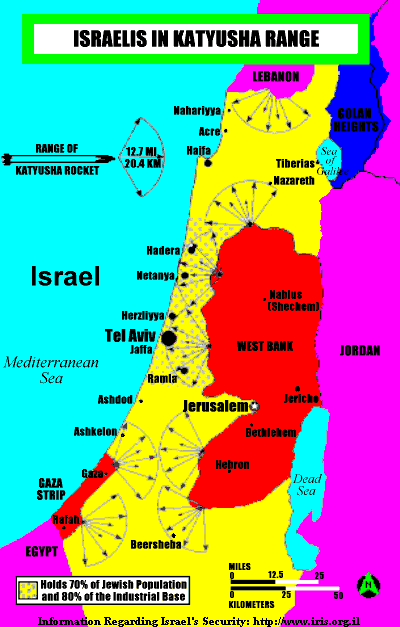
I remember when those of us who, in protest against proposed Israeli territorial concessions fifteen years ago, distributed maps like this one were derided, scorned and mocked as hysterical, scaremongering radical right-wing extremist nuts.

But even we didn't dare suggest a threat map like this, or this, or this, or this. That would have been certifiably insane.

So, after all these years, it pains me to admit how wrong we really were. All we right-wing extremists, clutching to scaremongering scenarios of doom should Israel hand over strategic territory to our enemies, were way off base.

Turns out we were at least an order of magnitude too optimistic. The small comfort is that they haven't managed to get rockets into the "West Bank". Yet.

(Doesn't that 20.4km Katyusha range look quaint?)

Monday, October 20, 2008

Mitzvot that crack my back

1. Sleeping in the sukkah - can anyone recommend a good portable mattress? I've tried sleeping bags, folding cots and air mattresses (which are better), but I still wake up pretty stiff.

2. Standing in shul on Yom Kippur. (Not exactly a mitzvah, but still!) From my shoes to G-d's ear, I hope.

3. Pesach cleaning - specifically crouching to clean the oven and fridge.

Am I missing any?

Chag sameach, and farewell to the sukkah for another year.

Tuesday, August 26, 2008

I won't be voting this year

As a dual US-Israeli citizen, I usually make it a point to cast my ballot in the American elections. It's my legal right and (arguably) civic obligation, so long as I retain the rights and obligations of an American citizen.

But this year I don't plan to vote.

A Zionist epiphany? A bout of political disillusionment? Dissatisfaction with the choice of candidates?

No, none of that. I retain my Republican sympathies and, with all his flaws, I'd like to see McCain move in to the White House next January.

But I can't work up the motivation to go out of my way to engage in a meaningless gesture.

As an overseas resident, I cast my vote in the state of my last legal residence. As it happens, it's about as left-leaning as a state can be without being in Europe. It hasn't voted for a Republican candidate for president since 1988. If it were even conceivable that it would break Republican, it could happen only if (as in 1988) the Republican candidate were so far ahead nationally that it wouldn't matter anyway.

Which means my lonely absentee ballot would be about as influential as Hillary's roll call vote, but without the symbolic significance.

If I were visiting the old hometown anyway, I'd stop by the polling center to cast my vote. No big deal.

But to have to fill out an absentee ballot request, post it at my expense overseas, wait expectantly for the ballot, seal it in the requisite number of envelopes and signatures and attach another round of airmail stamps - just to cast a vote which won't change a thing? Not this time.

Maybe next time there will at least be a close race for Congress. Otherwise, I'm sorry I didn't live in Pennsylvania or Florida.

Wednesday, May 07, 2008

Yom Ha'atzmaut is political

Yom Ha'atzmaut is political, they say, and thus has no place in our religious liturgy.

They are half right: Yom Ha'atzmaut is indeed political.


Furthermore, the story of Avraham is political.

The stories of Yitzhak, Yaakov and Yosef are political.

The story of Moshe is certainly political - Pesach is political.

The books of Bamidbar and Devarim are political.

Sefer Yehoshua is political, as are Shoftim, Shmuel and Melachim.

The latter prophets were political too.

The first Rashi on the Torah is political. So is the first Ramban.

Rosh Hashana is political. (Read the middle brachot of the Amidah.)

Purim is political.

Chanukah is political.

Tisha B'Av is political. As are Shiva Asar B'Tamuz, Asarah B'Tevet and Tzom Gedaliah.

The books of Ezra and Daniel are political.

The benching is political. So is the daily Amidah.

The rabbis of the Talmud were political. Some of them were even politicians.

Bar Kochba and Rabbi Akiva were political.


The mission of the Jewish people, from Abraham on, has been to develop a sovereign nation in its own land which sets an example for mankind - a light unto the nations - by worshiping God according to the Torah. Our story has been one of steps forward towards that goal - events of redemption - and of unfortunate failures and defeats - events of destruction and exile.

Yom Ha'atzmaut celebrates the most significant accomplishment towards our national mission in some 2000 years: reestablishing Jewish sovereignty over our homeland, a necessary prerequisite for the possible fulfillment of our national destiny. Its achievement on the heels of one of our greatest tragedies in history made it all the more miraculous.

We don't know what the state will bring in the long run. Will we fulfill our highest visions, or once again, God forbid, lapse into failure and ruin? We can't know that, any more than newlyweds can know whether their marriage will thrive or wither. That's no reason not to celebrate the achievement and thank God for making it possible.


Yom Ha'atzmaut is political. It is a major milestone in the achievement of our timeless national purpose as set out in the Torah. To leave it out of our religious liturgy would be a sign of ingratitude and historical blindness.

Chag sameach!

Thursday, April 24, 2008

Make matzah, not chametz

What's the difference between chametz and matzah?

Don't all answer at once.

Seriously, bear with me here. What's the basic, chemical, cookbook-recipe difference between chametz and matzah?

Simple. To make chametz, just mix flour and water and leave the dough alone. After a modest amount of time (halachically, we assume 18 minutes), the dough will begin to ferment as invisible yeast cells found naturally in the environment get to work on it. The surface starts to glisten and crack. Voila, chametz! (Interestingly, the first recorded evidence of leavened bread comes from ancient Egypt.)

To make matzah, bake the dough thoroughly before it has time to ferment.

Chametz, then, is the natural end result of the process begun when flour and water are mixed. Flour + water + time = chametz.

Matzah, on the other hand, is the result of a deliberate intervention to prevent the fermentation process from developing.

If you've ever visited a matzah bakery, you know how much easier it is to produce chametz than matzah. Chametz happens. Matzah must be made. The natural progression of dough into chametz must be stopped.

We can see this intervention into the development of chametz as a metaphor for divine intervention into history. The midrash famously describes the Israelites in Egypt as having descended over the years of assimilation and slavery into the 49th and lowest level of tumah (impurity or depravity); any longer and they would have been beyond redemption. So God intervened, taking them out of Egypt so they could be rededicated to His service.

The flour of Israel had spent a dangerously long time fermenting among the waters of Egypt. It had to bake in the fiery desert before it irreversibly became chametz.

Or we can see the creation of matzah as a metaphor for our personal spiritual lives. It is easy for us to go with the flow, to persist in harmful patterns of behavior or life situations, even though they will naturally worsen until they cause us irreversible damage. "Baking the matzah" is intervening in our lives or those of our loved ones to fix those errors before it's too late.

You can't turn chametz back into matzah. Chametz is natural, it's easy, it requires no effort on our part to create. Only benign neglect and the passage of time.

Making matzah requires alertness, careful action, prompt intervention into a developing process. It's much harder than making chametz. It needs some assistance from heaven.

Hey, no one ever said Pesach was easy.

Update: I forgot one last point:

You can't make matzah without making dough. Matzah is not simply non-chametz; it is almost-chametz. Unless you start with flour and water made into dough, you can't end up with matzah any more than you can end up with chametz.

The same goes for the Israelites in Egypt. They were enslaved, both physically and spiritually. No one would have chosen their situation voluntarily and consciously. Given more time, they could have been forever doomed. Yet it is only as a result of their sojourn as slaves in Egypt that they could emerge as the newly-born nation of Israel. They could never have become matzah had they not been at palpable risk of becoming chametz.

And in many ways, that is the essence of Jewish national identity to this day. We are the anti-slaves, anti-enslavers, dissidents to tyrants throughout history. We freely worship the one God who created all men as equal reflections of his divine image. Could the Jews be who we are today had we not endured slavery ourselves?

Without the potential of chametz, you can't make matzah.

My annual surge

My, has it only been a year since my last post? It seems like so much longer. (I suppose it has been much longer since I've been blogging regularly. And I'm not planning to start now.)

So what happens to a dormant blog whose barely-relevant title happens to refer to an actual annual event? The answer is below:


You can hardly tell that April 18 was the date of biur chametz this year, can you? (Well, technically it was the 19th, but that was Shabbos.)

Chag sameach!

Monday, February 19, 2007

McCain casts aside an age-old tradition

I don't have strong feelings about John McCain or his candidacy for the Republican nomination. But I have to comment about his website.

McCain has long been trying to position himself as an unconventional Republican candidate, which is fair enough. So his team has designed a somewhat unconventional website, which you may or may not care for. (Personally, I don't see the point of campaign websites, however designed.)

What irks me is the description. Both the home page and the press release call the site "a departure from the traditional campaign website".

Traditional?

The web has been around for under fifteen years. The first campaign websites were probably online in 1996 at the earliest. Ten years of graphic design fashion - is that what passes for a tradition these days? And for a Republican presidential candidate, no less?

I'm not sure campaign websites have been all that similar to begin with, or, if they have, that McCain's is all that different from them. I might be willing to grant him "unconventional". But "a departure from the traditional campaign website"? Please.